Story No 0011
Charles City, Iowa
Interview 11/7/2026
Historical Information
Company: Oliver Corporation
Location: Charles City, Iowa
Subject: Tractor testing and engineering
Oral History: Dallas Foster
Historical Contributor: Wayne Wiltse
Research and Compilation: Tracy Anderson
Photographs: Tracy Anderson taken at Floyd County Museum. Historical photos credited individuals.
The Oliver Dyno Car
Story By Dallas Foster and Wayne Wiltse
Oliver's Dyno Car: Testing Tractor Power
Before Oliver tractors went into production, they were put through a variety of tests to measure performance and durability. At the Oliver plant in Charles City, Iowa, the Experimental Department used specialized equipment to evaluate how tractors performed under different working conditions. One of these machines was the dyno car.
Early Tractor Testing
Oliver tested tractors long before its dedicated test track was established. An early photograph shows an Oliver Row Crop 77 pulling a wheeled apparatus with two men riding on the equipment behind it. The photograph provides an example of the testing equipment used during that period, although the exact purpose of the apparatus has not been confirmed. As tractors became larger and more powerful, Oliver's testing equipment also changed.
Dallas Foster and the Dyno Car
Dallas Foster worked with Oliver's Experimental Department during portions of the 1960s and 1970s. He also worked as an aircraft mechanic during the Vietnam War. His coworkers described him as patient, precise, and capable of repairing almost anything. Dallas worked with the dyno car at the Oliver plant and shared information about its operation. The dyno car was a mobile testing unit equipped with instruments to measure tractor performance. It had an enclosed cab and its own engine, which allowed it to move between locations. The engine was not intended to provide the pulling power during testing. That work was done by the tractor being evaluated.
How the Dyno Car Worked
The tractor being tested pulled the dyno car, which was connected to specially modified tractors that provided resistance. These load tractors had much of their sheet metal removed and were equipped with large, worn tires mounted backward and filled with liquid ballast to increase weight. The dyno car was equipped with instruments that allowed operators to monitor the tractor's performance under different loads. According to Dallas Foster, the dyno car used a frictionless hydraulic cylinder without seals to measure pulling force. As the tractor pulled against the resistance, force was applied to the cylinder, creating hydraulic pressure that could be measured by the instruments. This allowed operators to determine the tractor's drawbar pull during testing.
Oliver's Test Track
Oliver's test track in Charles City was used for several types of tractor evaluations. Wayne Wiltse, who worked in the Experimental Department, described the track and adjoining building in his written recollections. Testing included vibration, steering, endurance, sound measurement, and preparation for the Nebraska Tractor Test. Wayne also described several pieces of specialized equipment. One was an older load unit from the 1960s, which he described as an engine mounted over an axle. Another was an articulated tractor frame with its engine removed and replaced by two Lear Siegler eddy current generators. These generators provided adjustable resistance during testing. The Experimental Department also used equipment known as the chariot. This was a large framework with an elevated cab containing steering, throttle, and other controls. It allowed an operator to remotely drive a tractor over the rough bump section of the track without sitting on the tractor itself. The older and newer load units described by Wayne show that Oliver used different methods of applying resistance. Their exact relationship to the surviving dyno car has not yet been established.
Keeping the Test Track Open
The test track was used throughout the year, including during winter. Wayne recalled a time when approximately six inches of snow fell overnight. Several employees went to clear the track, but initially none of the equipment would start. They eventually got an Oliver front-wheel-assist tractor with a snowplow blade running. Dallas Foster drove the first lap before handing the controls to Wayne. The tractor's cab had no heat, and Wayne operated it until he became too cold. They then switched places again. A White 2-65 tractor with a loader was also used to help remove snow. Although the work took longer than expected, the crew had the track cleared and ready for testing by the following day.
The Surviving Dyno Car
One Oliver dyno car was preserved at the Floyd County Historical Museum in Charles City, Iowa. Photographs taken by Tracy Anderson at the museum show the machine's blue enclosed cab, Oliver engine, seating, gauges, and control panels. Inside the dyno car's cab, a light bulb was installed beneath the instrument panel. According to Dallas Foster, the bulb served a practical purpose: keeping the operator's feet warm during cold-weather testing. The surviving machine provides an opportunity to examine the equipment used in Oliver's tractor testing operations.
Preserving the History
Oliver's Experimental Department used several types of equipment to measure tractor performance, durability, and operating characteristics. The dyno car was one part of that testing process. Dallas Foster's recollections provide information about the modified tractors, resistance controls, and procedures used during testing. Wayne Wiltse's written accounts provide additional information about the test track, later testing equipment, and daily operations in the Experimental Department. Together with historical photographs and the surviving equipment, these accounts help document how Oliver tested its tractors at Charles City. Sources and acknowledgments: Dallas Foster, former Oliver Experimental Department employee, recollections of dyno car equipment and testing procedures. Wayne Wiltse, former Oliver Experimental Department employee, written recollections of test track equipment and operations. Historical photograph of an Oliver Row Crop 77 with testing apparatus, date and original source to be confirmed. Dyno car photographs by Tracy Anderson, taken at the Floyd County Historical Museum in Charles City, Iowa. Compiled by Tracy Anderson for Collecting Stories and the Oliver Company Historical Archives.
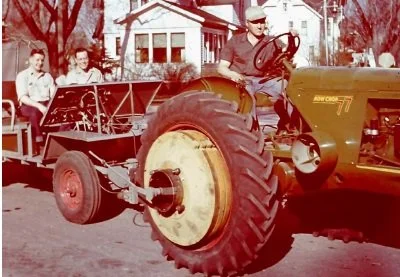
Historical photograph of an Oliver tractor pulling road-testing equipment with two people seated behind it on a street in Charles City, Iowa.
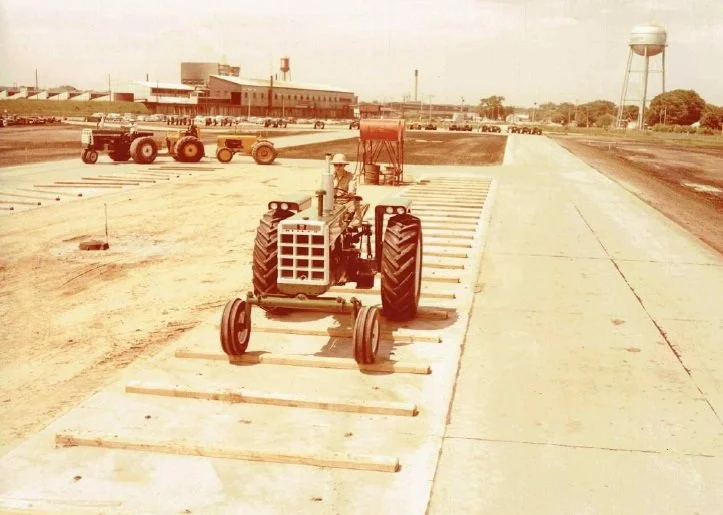
An Oliver tractor undergoes durability and ruggedness testing on a specially designed test track. The tractor travels over a series of raised wooden obstacles, simulating rough field conditions and placing repeated stress on its components. These tests helped Oliver engineers evaluate the tractor's strength, reliability, and performance under demanding conditions.
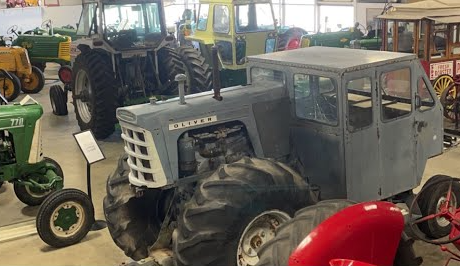
The Oliver dyno car on display at the Floyd County Museum in Charles City, Iowa. This specialized vehicle was used by Oliver engineers during tractor testing.
Photograph by Tracy Anderson.
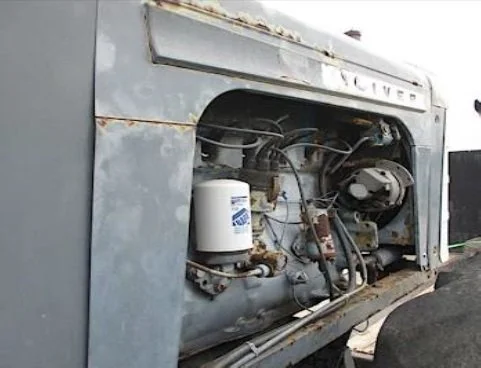
A closer look inside the side compartment of the Oliver dyno car, showing its mechanical components, hoses, piping, and filtration equipment.
Photograph by Tracy Anderson at the Floyd County Museum, Charles City, Iowa.
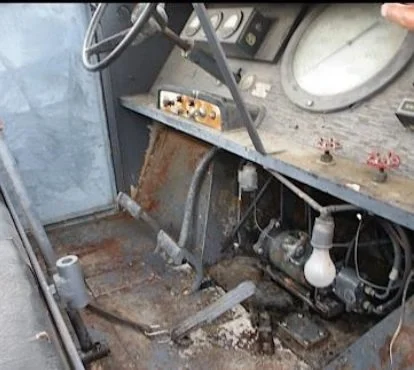
Interior view of the Oliver dyno car showing the instrument panel, controls, and a light bulb used to provide warmth for the operator's feet during testing.
Photograph by Tracy Anderson at the Floyd County Museum, Charles City, Iowa.
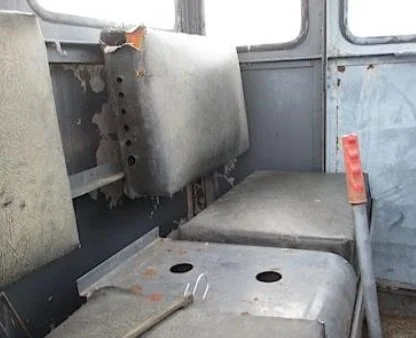
A look at the simple, utilitarian seating inside the Oliver dyno car. With its thin padding and basic construction, comfort clearly wasn't the priority. The seating offers a glimpse into the working conditions experienced by Oliver's tractor testing personnel.
Photograph by Tracy Anderson at the Floyd County Museum, Charles City, Iowa.
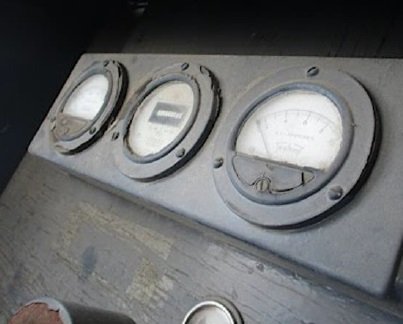
A close-up of three gauges mounted in the Oliver dyno car's instrument panel. These instruments provided operators with information during tractor testing. The worn surfaces offer a glimpse into the equipment used by Oliver's testing personnel.
Photograph by Tracy Anderson at the Floyd County Museum, Charles City, Iowa.
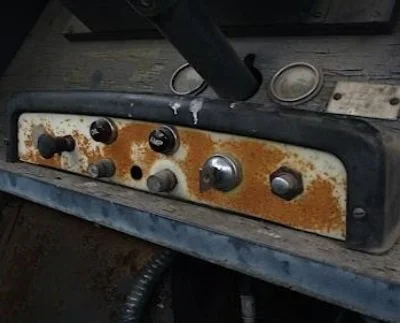
Close-up of a weathered metal control panel inside the Oliver dyno car, showing several switches, knobs, and rusted surfaces.
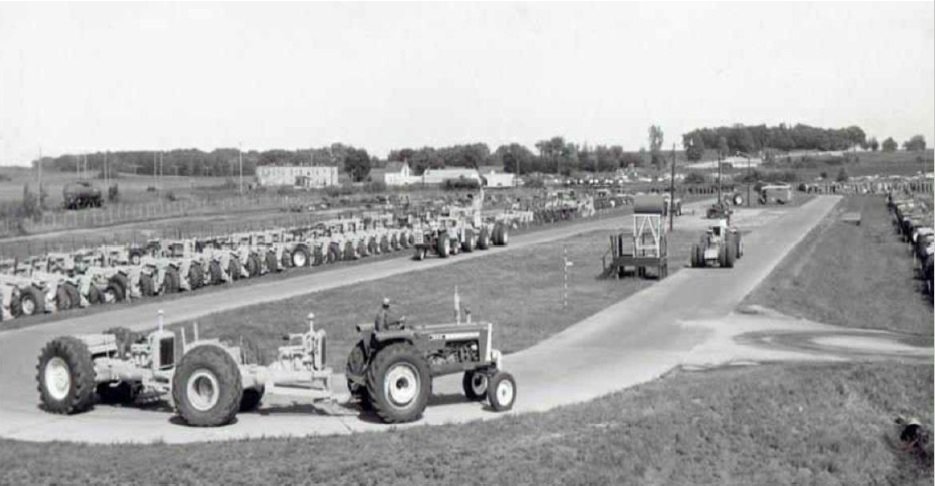
Historic black-and-white photograph of Oliver's Charles City test track, showing rows of completed tractors awaiting shipment, the dyno car operating on the track, and a tractor pulling two stripped-down tractors used as weights.